How AI Analyses Customer Behaviour for Inventory
Browsing patterns predict purchases 3–5 days before checkout. See how AI turns clickstream and cart data into accurate reorder timing → Full breakdown
Hylke Reitsma is co-founder of Forthsuite and a supply chain specialist with 8+ years of hands-on experience at Shell, Verisure, and...
How AI Analyses Customer Behaviour for Inventory
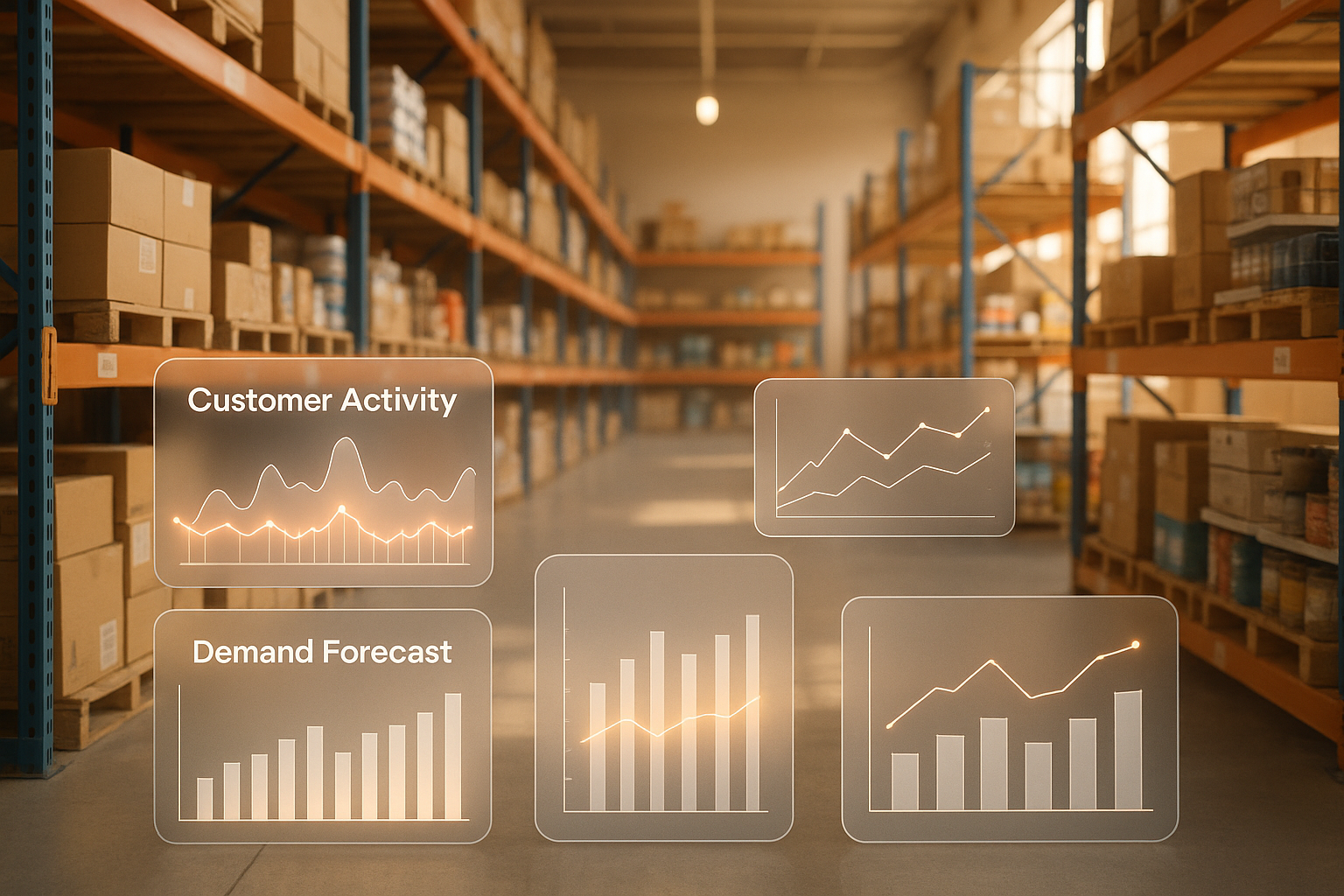
TL;DR: AI is reshaping inventory management by using customer behaviour data to predict demand and manage stock levels more accurately. Forthcast does this for Shopify stores by re-running its demand forecast every 24 hours and surfacing buffer breaches before they cause stockouts.
AI is reshaping inventory management by using customer behaviour data to predict demand and manage stock levels more accurately. Businesses no longer rely solely on historical sales data but integrate browsing habits, purchase patterns, and external factors like weather or economic trends. This approach reduces stockouts, lowers inventory costs, and improves customer satisfaction.
Key points:
- 71% of customers switch brands due to stockouts, showing the need for accurate forecasting.
- AI-driven demand forecasting improves accuracy by up to 50%, cutting inventory costs by 20-30%.
- Platforms like Forthcast analyse customer data - such as browsing habits, abandoned carts, and reviews - to predict unconstrained demand and optimise inventory.
AI tools also automate stock management, identify anomalies, and adjust for factors like promotions or seasonal trends, ensuring businesses stay ahead of demand shifts. By combining real-time data with machine learning, companies can make smarter, data-backed decisions.
AI Inventory Management: Predict Demand, Prevent Stockouts
Customer Behaviour Data Points AI Uses
AI systems rely on three main categories of customer behaviour data to generate accurate inventory forecasts. These categories offer insights that go beyond understanding what customers have already purchased - they help businesses anticipate what customers are likely to buy in the future.
Past Sales and Purchase Patterns
Historical sales data is the backbone of AI forecasting. Metrics like sales figures, purchase frequencies, customer lifetime value, and seasonal trends all play a critical role. Statistical models identify recurring patterns, while machine learning digs deeper into complex trends unique to each business.
For example, AI might notice that customers who buy one product often follow up with related purchases. This allows businesses to stock complementary items in advance, rather than waiting for demand to appear.
This kind of data is especially useful for subscription-based products or consumables. Take skincare products, pet food, or office supplies - AI can predict when customers are likely to reorder, enabling automated inventory adjustments. This helps prevent stockouts during peak demand periods. These insights also set the stage for analysing real-time customer behaviour.
Customer Engagement and Preferences
Digital interactions provide a treasure trove of data about customer intent, which AI uses to refine its predictions. By analysing website clicks, product views, time spent on pages, cart additions, abandoned baskets, and even social media activity, AI can often detect purchasing intent before a sale even happens.
For instance, a 2023 study revealed that customers who viewed more than five items in a category were 70% more likely to make a purchase within 48 hours. Insights like these allow businesses to make real-time inventory and marketing adjustments.
Wishlist additions and product reviews are also key indicators. When customers add items to wishlists or leave glowing reviews, it signals growing interest. On the other hand, negative reviews or drops in engagement might suggest it’s time to scale back inventory for certain products.
Social media adds another layer of insight. AI can track mentions and sentiment on platforms like Instagram or TikTok, identifying products that are gaining popularity. This enables businesses to prepare for surges in demand driven by viral trends.
AI also segments customers based on engagement patterns. For example, it might notice that mobile users browse differently from desktop users or that customers in specific regions have distinct preferences. These insights allow businesses to fine-tune their inventory strategies by location or customer type.
External Factors That Affect Behaviour
AI doesn’t just look inward - it also considers external factors that influence customer behaviour. Buying habits are shaped by a variety of outside influences, and AI integrates these into its forecasts. Key factors include seasonality, economic trends, weather conditions, promotional calendars, and supply chain disruptions.
Seasonal trends are among the easiest to predict. For example, AI can automatically increase umbrella stock before a rainy spell or boost toy inventory in the lead-up to Christmas. Real-time weather and economic data further refine these predictions.
Economic conditions also play a big role. During uncertain times, customers may hold off on luxury purchases or opt for budget-friendly alternatives. By monitoring economic indicators, AI can help businesses adjust their inventory to avoid overstocking high-priced items when demand is low.
Supply chain disruptions add another layer of complexity. For instance, longer international shipping times are factored into AI calculations, ensuring businesses order stock early enough to avoid running out.
Promotional events and marketing campaigns can create short-term spikes in demand. By aligning promotional calendars with customer behaviour data, AI predicts how different customer groups will respond to sales events, helping businesses prepare inventory more precisely.
AI Methods for Analysing Customer Behaviour
Once customer data is collected, AI steps in to transform raw information into actionable insights, helping businesses anticipate demand with precision.
Machine Learning Models and Algorithms
Machine learning plays a central role in understanding customer behaviour. For instance, time series analysis uses historical sales data to uncover seasonal trends and cyclical patterns. Meanwhile, clustering algorithms categorise customers based on shared behaviours or preferences. On top of that, regression models assess how factors like promotional campaigns or weather influence sales, which helps fine-tune demand predictions.
"Machine learning adds adaptability, learning from complex trends and adjusting predictions based on your shop's unique data." – Forthcast
By combining statistical methods with machine learning, AI systems can identify patterns specific to a business. For example, analysis might show that customers who view more than five items are 70% more likely to make a purchase within 48 hours. Insights like these guide smarter inventory management strategies, ensuring stock levels align with demand.
Anomaly Detection and Trend Analysis
Anomaly detection serves as an early warning system by pinpointing irregular sales patterns that could signal new opportunities or potential problems. For example, if a product suddenly experiences a spike in sales outside its usual season, AI flags this as an anomaly. This alert enables inventory managers to investigate and adapt stock levels promptly. At the same time, trend analysis identifies shifts in customer preferences, allowing businesses to adjust their inventory and marketing plans in advance.
Forthcast incorporates advanced anomaly detection as a standard feature in its forecasting toolkit. This ensures that forecasts capture true demand without being skewed by outliers, helping businesses avoid both overstocking and stock shortages.
Natural Language Processing for Sentiment Analysis
AI doesn’t just rely on numbers - it also analyses unstructured data to gain deeper insights. Natural Language Processing (NLP) plays a key role here, examining customer reviews, social media posts, and other feedback to gauge sentiment about products and brands. Positive sentiment might suggest increasing demand, prompting businesses to stock up, while negative sentiment may indicate the need to scale back or re-evaluate certain products.
Social media analysis, in particular, can highlight emerging trends before they become mainstream. This allows businesses to adapt their inventory to meet changing consumer interests quickly. By revealing not only what is happening but also why, NLP helps companies make more informed decisions about product offerings and adjustments.
| Method | Data Used | Business Impact |
|---|---|---|
| Machine Learning | Historical sales, customer behaviour, external factors | Precise demand forecasting and optimised stock levels |
| Anomaly Detection | Real-time sales data, historical patterns | Early detection of unusual sales for timely actions |
| NLP for Sentiment Analysis | Customer reviews and social media | Better understanding of customer satisfaction and inventory choices |
sbb-itb-499c055
Using AI Insights in Inventory Management
AI takes raw customer data and turns it into practical inventory strategies, helping businesses optimise stock levels and boost profitability. The real advantage emerges when these insights lead to proactive decision-making, ensuring inventory aligns with customer demand. This approach enables precise SKU-level forecasting, which we’ll delve into next.
Real-Time Demand Forecasting
AI doesn't just rely on historical averages anymore. By analysing customer behaviour in real time, it predicts demand at both SKU and location levels. This detailed insight allows inventory managers to make decisions based on current trends, not outdated data.
Take the example of a major online fashion retailer in 2023. They used a Customer Behaviour Analysis AI Agent to segment users and predict their purchasing habits. By adjusting stock levels and marketing efforts based on live browsing patterns, they reduced stockouts and increased customer satisfaction.
AI also captures unconstrained demand - the hidden signals from browsing behaviour, abandoned carts, and search queries that go beyond completed purchases. Platforms like Forthcast combine statistical analysis with machine learning to spot these patterns. By balancing historical data with evolving trends, Forthcast ensures its predictions remain reliable, even as customer preferences shift.
Automated Stock Management
AI has turned inventory management into a proactive process. It automates responses to live demand, making manual guesswork a thing of the past. Features like smart reorder alerts and real-time inventory adjustments streamline stock management.
For instance, these systems can dynamically adjust reorder points based on live sales data, seasonal trends, or promotional campaigns. If a sudden demand spike occurs, the AI triggers alerts or updates forecasts to prevent stockouts.
Forthcast includes automated low stock alerts and smart reorder suggestions as part of its standard offering. Its anomaly detection tools highlight unexpected sales patterns, enabling quick responses to market changes.
The impact of AI-driven inventory management is hard to ignore. Studies show it can cut inventory costs by up to 30%, logistics expenses by up to 20%, and procurement spend by up to 15%. These savings not only improve profitability but also ease the workload for inventory teams.
Customisation and Risk Management
AI doesn’t stop at automation - it allows businesses to fine-tune inventory strategies to meet specific needs and risk levels. Instead of a one-size-fits-all approach, companies can customise service levels and tweak forecast parameters for different situations.
This flexibility is especially useful for seasonal events, promotions, or product launches. Companies can assign higher service levels to high-margin items while being more flexible with lower-value stock. For example, Forthcast lets users set service levels and create tailored forecast adjustments for special events, balancing holding costs with the risk of stockouts.
AI also strengthens risk management by identifying potential supply chain disruptions and assessing the impact of lead time changes. This holistic approach helps businesses remain resilient while keeping costs in check across the supply chain.
| AI Feature | Business Benefit | Risk Mitigation |
|---|---|---|
| Real-time demand forecasting | Accurate SKU-level predictions based on live customer behaviour | Reduces stockouts and avoids overstocking |
| Automated reorder alerts | Cuts inventory costs by up to 30% | Prevents emergency orders and rush fees |
| Custom service levels | Tailored strategies for different product categories | Balances holding costs with product availability |
Challenges and Best Practices
While AI-driven inventory insights can be a game-changer, they’re not without their challenges. Successfully implementing these systems requires addressing potential pitfalls, such as poor data quality, integration hurdles, and the difficulty teams may face in interpreting AI outputs. Tackling these issues head-on helps businesses avoid costly mistakes and ensures they get the most out of their AI tools.
Resolving Data Quality and Integration Issues
One of the most significant barriers to effective AI implementation is poor data quality. Common problems include incomplete sales records, inconsistent product categorisation, duplicate entries, and outdated customer information. These issues can skew demand forecasts, leading to stock shortages or overstocking. For example, missing transaction data can cause AI models to underestimate demand, resulting in empty shelves and unhappy customers.
In the UK, many retailers face additional challenges when integrating AI with older ERP systems or managing data from multiple sales channels. These integration issues can slow down the adoption of AI tools and limit their effectiveness.
The solution? Start by standardising data formats and using robust APIs to ensure seamless integration. Middleware solutions can help bridge the gap between legacy systems and modern AI tools. For instance, connecting point-of-sale data with AI inventory platforms allows for real-time stock updates and more accurate forecasting.
Maintaining data quality requires a proactive approach. Automated validation processes, regular deduplication, and strict data governance policies are essential. Training staff to handle data correctly and scheduling routine checks for anomalies can also prevent issues from escalating. These proactive steps save both time and money compared to fixing problems after they arise.
Once data quality is under control, the focus shifts to making sense of AI-generated insights.
Understanding AI Results
Even with clean data, many businesses struggle to interpret AI outputs and turn them into actionable decisions. AI insights are only useful when they clearly inform practical inventory strategies. This challenge becomes even more pronounced when AI recommendations contradict traditional approaches or seem counterintuitive.
To make AI insights more accessible, businesses should invest in visual dashboards and clear reporting formats. These tools simplify complex data, making it easier for non-technical staff to understand. Training programmes that cover basic AI concepts can further bridge the gap, helping teams grasp why the system makes specific recommendations.
AI models should also include self-assessment features to measure their accuracy. Key metrics like bias (the tendency to overestimate or underestimate) and accuracy (how close predictions are to actual results) provide valuable context. By understanding these metrics, businesses can identify whether their AI consistently leans in one direction and how significant its errors are.
Collaboration is key. Regular discussions between data analysts and inventory managers ensure that AI insights are not only understood but also applied effectively. When teams know why the AI suggests certain actions, they’re more likely to trust and act on its recommendations.
Best Practices for Ongoing Improvement
AI systems aren’t “set it and forget it” tools - they require continuous attention to stay effective as markets and customer behaviours change. Businesses that prioritise ongoing improvement see better results over time.
Regular model evaluations are crucial. Depending on the business cycle, these should be conducted monthly or quarterly. Comparing predicted sales to actual outcomes helps identify where the system is falling short, while error analysis can uncover recurring issues. Tools like Forthcast simplify this process by offering built-in accuracy tracking and bias analysis.
During promotions, seasonal events, or product launches, AI systems benefit from additional context. Instead of relying solely on historical data, businesses should input information about upcoming campaigns or market shifts. This collaboration between human expertise and machine learning leads to more accurate predictions.
Cross-functional reviews are another best practice. Teams from sales, marketing, and operations should regularly assess the AI’s performance and provide feedback. This ensures the system adapts to changing conditions rather than becoming outdated. Testing improvements in high-impact areas before rolling them out company-wide can also minimise risks.
Ultimately, AI should be treated as a dynamic tool that evolves with regular refinement. Businesses that invest in this approach consistently improve their forecasting accuracy and inventory management over time.
Conclusion
AI-driven analysis is revolutionising inventory forecasting, turning it from a game of guesswork into a science of precision. By examining a wide range of data - such as purchase trends, browsing habits, and external factors like seasonality - AI enables businesses to predict demand with impressive accuracy. This helps retailers strike the perfect balance between maintaining stock levels and cutting unnecessary costs.
The benefits of AI in inventory management are clear: reduced holding costs, fewer stock discrepancies, faster turnover, and fewer lost sales. These advantages are especially critical when 71% of customers are willing to switch brands due to stockouts.
AI addresses a major gap in the market by transforming outdated forecasting methods into real-time, dynamic inventory adjustments.
For e-commerce retailers eager to embrace these advancements, platforms like Forthcast offer a robust solution. With tools such as AI-driven demand forecasting, anomaly detection, SKU-level analysis, and automated reorder alerts, Forthcast empowers businesses to avoid stockouts, cut down on excess inventory, and make data-backed decisions that boost profitability. By combining statistical methods with machine learning, Forthcast ensures every prediction is grounded in real customer data, making it a key part of a proactive inventory strategy.
As supply chain disruptions remain a challenge - illustrated by lead times from China to the US increasing by 50% since 2019 - the ability to anticipate and adapt to demand changes has never been more essential. AI-powered analysis of customer behaviour not only helps retailers stay resilient but also improves customer satisfaction and strengthens their competitive edge.
FAQs
How does AI use customer behaviour and sales data to optimise inventory management?
AI leverages customer behaviour insights and historical sales data to deliver more precise inventory forecasts. By examining factors like buying patterns, seasonal demand, and customer preferences, it pinpoints the key drivers that impact stock levels.
Machine learning takes this a step further by continuously adjusting predictions based on fresh data - whether it's an unexpected surge in sales or a sudden change in consumer habits. This flexible system helps businesses strike the right balance in their inventory, avoiding both overstocking and running out of stock, while boosting overall supply chain performance.
What external factors does AI consider when forecasting inventory demand, and how do these influence predictions?
AI takes into account a range of external factors when predicting inventory demand, including seasonal trends, promotional events, economic conditions, and market demand shifts. These elements help fine-tune forecasts by considering the ups and downs that can influence customer buying habits.
Take holiday seasons, for instance. AI can predict a surge in demand for certain products, helping businesses ensure they have the right stock levels. It also examines economic data and regional patterns, enabling companies to adapt their inventory strategies ahead of time. This reduces the chances of running out of stock or ending up with excess inventory. By weaving in these insights, tools like Forthcast deliver more precise and adaptable inventory forecasts that reflect actual market conditions.
How can businesses maintain high data quality and ensure smooth integration when adopting AI-driven inventory systems?
To ensure top-notch data quality and smooth integration, businesses need to prioritise dependable data sources and well-structured planning processes. Tools like Forthcast, powered by AI, play a key role here. They utilise advanced statistical analysis and machine learning to uncover patterns in historical data and adjust to shifting trends.
Forthcast takes it a step further with features such as anomaly detection, which highlights unusual sales behaviours, and forecast accuracy tracking, allowing businesses to fine-tune predictions over time. These capabilities empower companies to optimise inventory management and make well-informed, data-backed decisions.
About the Author

Hylke Reitsma is co-founder of Forthsuite and a supply chain specialist with 8+ years of hands-on experience at Shell, Verisure, and Stryker. He holds an MSc in Supply Chain Management from the University of Groningen and writes practical guides to help e-commerce teams run leaner, faster supply chains.
LinkedIn